Samsung Galaxy Z : TriFold Durability Test Reveals the Real Story Behind Its Triple Hinge Design
Samsung Galaxy Z: The launch of the Samsung Galaxy Z TriFold marked a significant milestone in the evolution of foldable smartphones. As the brand’s first triple foldable device, it immediately attracted global attention for its ambitious design, innovative display technology, and complex hinge mechanism. However, along with excitement came skepticism. Many users and industry observers questioned whether a device with three folding panels could realistically maintain long-term durability. To explore this concern, an independent durability test conducted on YouTube offered valuable insights into how the phone performs under extreme stress.
Introduction to the Triple Fold Concept
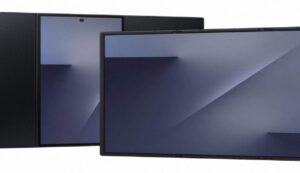
Foldable smartphones have already proven that flexible displays are viable for everyday use. With the Galaxy Z TriFold, Samsung pushed this concept further by introducing a triple folding design supported by dual hinges. This structure allows the device to transform from a compact phone into a large tablet-like display. While the design promises enhanced productivity and immersive viewing, it also introduces more mechanical components that could potentially fail over time. Samsung stated during launch events that the device underwent rigorous internal testing, but real-world experiments are often the true benchmark for durability claims.
Independent Durability Testing on YouTube
A South Korea–based YouTube channel known as OMG_electronics decided to evaluate Samsung’s claims through a continuous folding and unfolding test. The smartphone was placed into a mechanical setup that repeatedly folded and unfolded the device without interruption. This test ran for more than eight consecutive days, simulating years of usage in a highly compressed time frame. The goal was not to replicate normal user behavior but to push the hardware to its limits.
Early Signs of Wear in the Hinge System
As the test progressed, subtle changes began to appear in the hinge performance. After approximately 61,000 folds, the first hinge started producing faint creaking sounds. While this did not immediately affect usability, it indicated internal stress within the hinge mechanism. The second hinge remained stable for a longer period but eventually began showing similar audible signs after crossing roughly 121,000 folds. These sounds suggested increased friction or minor structural changes inside the hinge assembly.
Performance Decline After Extensive Folding
By the time the fold count reached around 144,000, the testers observed a noticeable decline in hinge elasticity. At this stage, the device no longer opened fully on its own. Additional manual force was required to keep the phone completely unfolded. Although the hinges were still functional, their resistance and smoothness were clearly reduced. This phase marked the point where mechanical fatigue became evident, especially considering the intensity of the testing conditions.
Display Reliability Despite Hinge Stress
One of the most important observations from the test was the condition of the display. Even as the hinges showed signs of wear, the flexible screen itself continued to function properly. Touch responsiveness, brightness, and visual output remained intact until the end of the test. This result highlights Samsung’s progress in flexible display technology and suggests that the screen may outlast the mechanical components that support it.
Understanding the Test Environment
It is essential to consider the context of this durability experiment. The phone was folded continuously in a short time span, far exceeding normal daily usage patterns. In real-world conditions, most users would fold their device only a limited number of times per day. The aggressive nature of this test was designed to accelerate wear and expose weaknesses, rather than reflect typical consumer behavior.
Comparing Official Durability Claims
Samsung claims that the Galaxy Z TriFold is engineered to withstand up to 200,000 folds, representing approximately 100 folds per day over five years. The independent test approached this figure under extreme conditions and revealed hinge degradation before reaching the claimed limit. However, this does not necessarily contradict Samsung’s statement, as laboratory testing environments often differ from real-world stress scenarios. It is also worth noting that other foldable models from Samsung are rated for even higher fold counts, indicating ongoing improvements in hinge engineering.
Final Thoughts on Long-Term Usability
The durability test provides a balanced perspective on the Galaxy Z TriFold. While the hinges showed signs of fatigue after extensive use, the device remained operational, and the display continued to perform reliably. For everyday users, this suggests that the phone is unlikely to encounter such extreme stress during its lifespan. The test reinforces the idea that triple foldable smartphones are still an evolving technology, with room for refinement in mechanical design.